Polls for producers: how real farms handle losses
Only about 50%[1] of US states still have a rendering plant, so every farm has worked out its own answer. These short polls let you see how your neighbors do it.
- Anonymous, one vote each
- Questions written for working farms
- Live results you can compare
Why we ask
Why we ask producers these questions
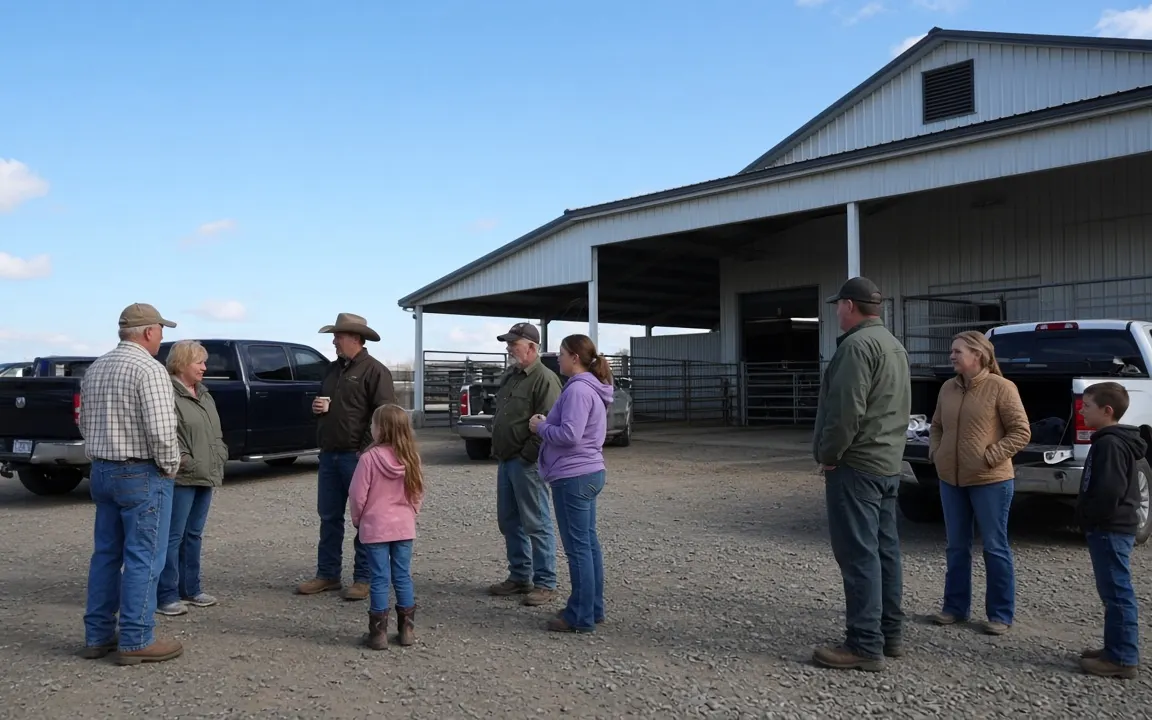
Official surveys tell us how many cattle, sheep and hogs die each year. They say much less about what happens next on an ordinary farm: whether the renderer still comes, whether people trust composting a big cow, or what a family does when their kid's show steer dies at home. Our polls try to fill that gap, one honest answer at a time.
Pick any poll below, vote, and you'll see the live tally straight away. Each takes a few seconds. There's no sign-up and we don't record who voted for what.
Browse every poll
How cattle, dairy, sheep, hog and poultry producers, ranches and show-animal families handle deaths on the farm.
When an adult animal dies on your place, what usually happens to it?
Tap an answer to vote and see how others answered. Anonymous.
If a show steer, heifer or lamb your family raised died at home, what would you want?
Tap an answer to vote and see how others answered. Anonymous.
Can you still get a renderer to pick up at your farm?
Tap an answer to vote and see how others answered. Anonymous.
Do you have a written plan for a big loss, like a blizzard, heat wave or disease outbreak?
Tap an answer to vote and see how others answered. Anonymous.
What feels like a fair price to deal with one dead adult cow?
Tap an answer to vote and see how others answered. Anonymous.
What kind of operation do you run?
Tap an answer to vote and see how others answered. Anonymous.
If you lost a lot of animals at once, what would worry you most?
Tap an answer to vote and see how others answered. Anonymous.
Have you ever composted a mature cow, steer or horse?
Tap an answer to vote and see how others answered. Anonymous.
Reading the results
How to read the numbers without over-reading them
These are reader polls, not a scientific survey. The people who vote are the people who found this site, often right after a loss or while planning for one. A poll where dairy farmers outnumber ranchers will lean toward dairy answers. That's why we ask about your operation too, so you can see who's answering.
What kind of operation do you run?
Tap an answer to vote and see how others answered. Anonymous.
When a result surprises you, compare it with the published research on our research page. The poll results page puts every live tally in one place and explains how votes are counted.
Question highlight
The renderer question: why access varies so much
We ask whether a renderer still picks up at your farm because the answer shapes everything else. Where one does, most routine losses are a phone call. Where one doesn't, you're into composting, burial or hauling, each with its own work and rules. The number of plants willing to take whole carcasses has shrunk over the years as regulations tightened. Our locations pages explain how rendering coverage and disposal rules differ by state.
Dead-stock handling isn't only about disposal, either. USDA's 2015 cattle death-loss study found 19.0%[2] of cattle operations used nonlethal predator control in 2015, and carcass removal is one of those methods: a dead calf left in the pasture teaches coyotes where dinner is. Our services page covers what to do when no truck comes.
Question highlight
The composting question: experience versus reputation
Extension services recommend composting widely, but plenty of producers have never tried it on a mature animal, and some tried once and gave up. We ask about experience because the gap between small and large animals is huge: the second composting phase takes about 10 days for a chicken and around 240 days[3] for a mature cow.
Have you ever composted a mature cow, steer or horse?
Tap an answer to vote and see how others answered. Anonymous.
If you're thinking about starting, the livestock mortality planner shows how much carbon material you'd need for your animals.
Question highlight
The outbreak question: what keeps producers up at night
Our poll on mass mortality asks what would worry you most: space, disease spread, water, money or the toll on family and crew. There's no right answer, but the question itself is a good prompt for a planning conversation. It's also where official findings are sobering.
608 premises audited (Jan-Sep 2025)[4]
If you keep poultry, the USDA avian influenza epidemiology report is worth a skim. By our estimate, infected premises in the outbreak since 2022 have averaged about 102,814 birds per premises[5], which shows how fast a single positive test can outgrow a farm's own compost space.
If a written plan is on your to-do list, start with our barn and feedlot pre-planning guide and share the staff briefing guide with whoever would be doing the work.
Question highlight
The show-animal question: when a project becomes family
We also ask what families would want if a 4-H or FFA animal died at home. Show animals sit in an odd place: raised to sell, but cared for daily by a child who often grieves like they've lost a pet. The poll includes "let the kid decide" because in a lot of families that's the real question underneath.
If a show steer, heifer or lamb your family raised died at home, what would you want?
Tap an answer to vote and see how others answered. Anonymous.
Research on pet loss suggests the closeness of the bond, not the species, drives how hard grief hits. Our page on grief after losing a livestock animal has ideas for helping children through it.
The full set
The eight questions we ask, and why each one is there
- What usually happens to an adult animal that dies? The baseline: rendering, compost, burial, landfill, lab or cremation.
- What would you want for a show animal? Because a 4-H steer often isn't handled like the rest of the herd.
- Can you still get a renderer? Access is shrinking, and it decides most other choices.
- Do you have a written plan for a big loss? The gap between having a plan and having it on paper.
- What's a fair price for one dead cow? Expectations against published costs.
- What kind of operation do you run? So you can see who's answering the rest.
- What worries you most about a mass loss? Where planning effort should go first.
- Have you composted a mature animal? Experience versus the extension-office recommendation.
We wrote each option the way a producer would say it, and we don't pre-fill any tally. If you want the figures that sit behind these questions, like how many cattle die each year or what composting costs per pound, the tools page and our services page cite them directly.
Poll questions are also a quiet way to start a hard talk at home. Asking a teenager which answer they'd pick for their show heifer is gentler than asking what they want done if she dies. If that conversation is coming, our guide to pre-planning livestock aftercare may help.

Reader polls
What would you choose?
Vote anonymously and see how other readers answered. The results are live counts from people who visit this site, so they show real opinions, not a scientific sample.
Can you still get a renderer to pick up at your farm?
Tap an answer to vote and see how others answered. Anonymous.
If you lost a lot of animals at once, what would worry you most?
Tap an answer to vote and see how others answered. Anonymous.
What was the hardest part of losing your pet?
Tap an answer to vote and see how others answered. Anonymous.



Questions people ask
Are the poll results a reliable picture of US agriculture?
No. They're a snapshot of the people who visit this site and choose to vote. For national figures, USDA surveys are the source; we link to them on our research page. Our polls are useful for seeing the range of real answers, not for measuring exact percentages.
Can I vote more than once?
Each poll counts one vote per person, so the totals aren't skewed by repeat clicking. If your situation changes, like finally getting a renderer or losing one, the result you see will still include your first answer.
Do you record who voted?
No. Votes are anonymous. We don't ask for your name, farm or location to vote, and we don't link poll answers to anything you send through the contact form.
Can I suggest a poll question?
Yes, please do. Some of our questions came from producers who wanted to know how others handle the same problem. Send your idea through the contact page, ideally with a sentence on why it matters on your farm.

Sources and our estimates
- [1] Only about 50% of U.S. states have rendering plants, most of them concentrated in the Midwest. Extension Horses (eXtension national Cooperative Extension) - Horse Disposal Options, 2019, 2019.
- [2] Livestock carcass removal is one of the nonlethal methods U.S. cattle operations use to control predators; nonlethal predator control use rose from 3.1% of operations in 2000 to 19.0% in 2015. USDA APHIS NAHMS - Death Loss in U.S. Cattle and Calves Due to Predator and Nonpredator Causes, 2015 (published Dec 2017), 2015.
- [3] The second composting phase takes about 10 days for chickens but approximately 240 days for mature cows and horses. USDA APHIS / Center for Food Security and Public Health (Iowa State) - Disposal: Composting, Rendering & Burial handout, based on NAHEMS Disposal Guidelines (2012), 2012.
- [4] USDA biosecurity audits after HPAI detections most commonly required fixes related to mortality management (dead-bird handling), wildlife access and visitor records. USDA APHIS CEAH - Status and Epidemiologic Analyses of HPAI-affected Poultry Flocks, September 30, 2025 Interim Report, 2025.
- [5] Each HPAI-infected premises averaged about 102,814 affected birds (Feb 2022-Sep 2025). Our estimate: 179,000,000 / 1,741. How we calculate.
Need options for your own farm?
Tell us what you need and where you are. We'll reply by email with clear options and prices so you can decide in your own time.