Which aftercare fits your show or family animal?
One industry report says about 40%[1] of consumers raise environmental concerns about aftercare. Tell this tool what you care about, and it ranks the options for your animal.
- Set your priorities with simple sliders
- Ranked options with pros, cons and costs
- Honest notes on what suits large animals
Aftercare options compared
Move each slider to show what matters most to you. The options re-rank as you go. There is no wrong answer.
1. Home burial
91% match
Typical US cost: Little direct cost (your time, tools, maybe a casket)
Good for
- Chosen by about 27% of UK owners
- A place to visit in your own garden
- Easy to hold a goodbye at home
- No crematorium involved
Keep in mind
- Local rules on depth and distance from water apply
- You may move house one day
- Not an option for renters or some areas
2. Water cremation (aquamation)
78% match
Typical US cost: Pet systems take up to about 550 lb per cycle; ask locally
Good for
- About a tenth of the carbon footprint of flame cremation
- Your pet's ashes are returned
- Uses water and alkali instead of flame
Keep in mind
- Fewer providers, so you may travel
- Cycle takes 12–20 hours
3. Private cremation
71% match
Typical US cost: $600–$1,000
Good for
- Your pet's own ashes come home
- Keep, scatter, bury or share them later
- Often 5–10 days to return
Keep in mind
- Uses fuel and emits CO2
- Costs more than communal
4. Pet cemetery burial
62% match
Typical US cost: Rarely offered for large animals; ask locally
Good for
- A permanent, cared-for place to visit
- Often includes a graveside service
- Stays put if you move
Keep in mind
- The most expensive option
- Plot fees and upkeep may continue
5. Communal cremation
56% match
Typical US cost: Few providers take large animals communally; ask locally
Good for
- Lowest cost option
- Nothing more to arrange afterwards
Keep in mind
- Ashes are not returned
- Little room for a personal goodbye
Match scores are our own guide to how well each option fits the priorities you set, not a rating of providers. Costs are for a 1,000 lb horse (US).
Source: Extension Horses (eXtension national Cooperative Extension) - Horse Disposal Options, 2019; Bio-Response Solutions — PET-550 Aquamation System product page; National Geographic — The environmental toll of cremating the dead (2019); UK Competition and Markets Authority - Veterinary services for household pets, Provisional decision report Part A (Oct 2025)
Next step: Compare local providers and prices →
Start here
This comparison is for animals you want to remember
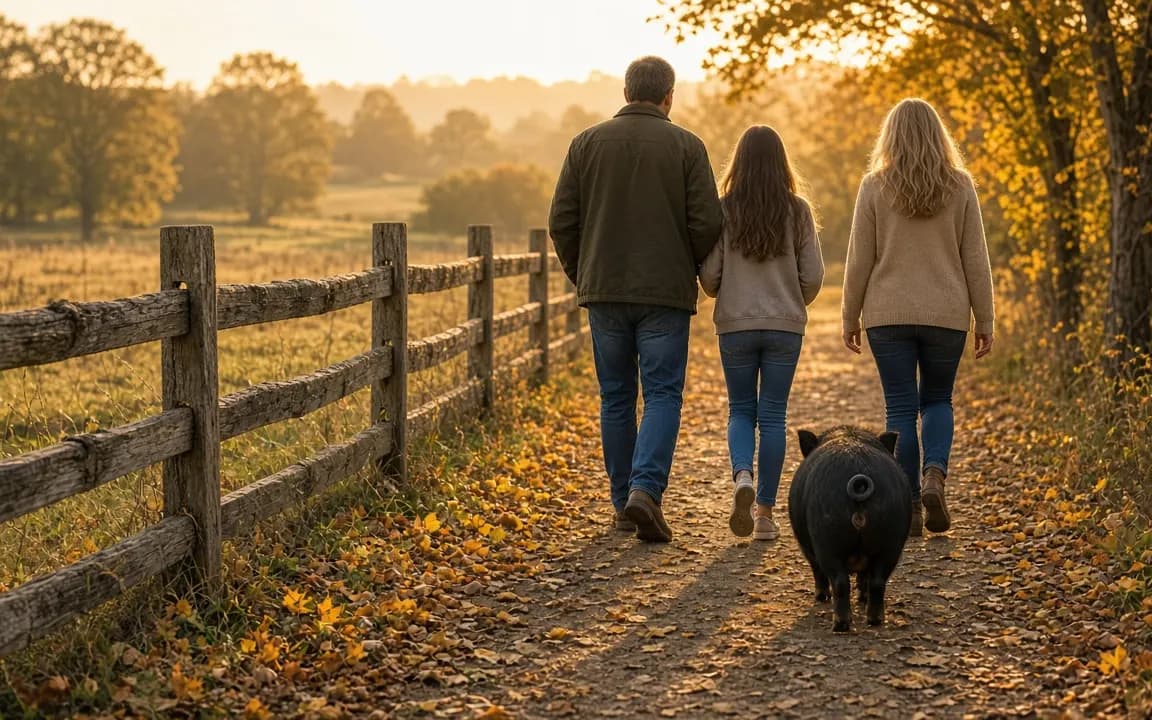
The comparison is built around options families choose for a named animal: private cremation, communal cremation, water cremation, burial on your land and a pet cemetery. It suits the 4-H goat, the pet pig, the retired dairy cow and the show heifer who never went to market.
Production losses need a different tool. Rendering, composting and bulk burial are compared in the livestock mortality planner and the large-animal cost comparison.
Using the tool
Setting the sliders
Five sliders, each from "Doesn't matter" to "Very important": keeping costs low, keeping them close, environmental impact, speed and simplicity, and room for a ceremony. Move them honestly. There's no wrong setting, and families often disagree, which is a useful conversation in itself.
The tool scores each option against your priorities and ranks them as cards, each with a match percentage, a typical US cost and short "Good for" and "Keep in mind" lists. On this site the private cremation card shows about $600 to $1,000, the reported cost for a 1,000 lb horse, while the communal, water cremation and pet cemetery cards tell you to ask locally rather than quote a pet price. Change a slider and the ranking reshuffles.
If a show steer, heifer or lamb your family raised died at home, what would you want?
Tap an answer to vote and see how others answered. Anonymous.
Size matters
How the options change for a large animal
The tool was designed for pets, so a few options need a livestock reality check. Water cremation (alkaline hydrolysis) dissolves soft tissue in warm alkaline water, leaving bone that's dried and ground like ash. It's gentle and low-carbon, but equipment is limited by size: one common pet unit, listed at USD 109,900[2], handles 1 to 550 lb per cycle. That covers a goat, lamb or pig, but not a grown steer. The Veterinary Sustainability Alliance's explainer on aquamation covers how the process works.
Pet cemeteries rarely accept an animal over a few hundred pounds. Burial on your land is often the most natural choice for a farm family, subject to your state's depth and setback rules, like the ones Penn State Extension summarizes for Pennsylvania. Private flame cremation is the only option that handles any size and returns the ashes, though a steer may need a specialist provider.
Worked example
Worked example: a 250 lb pet pig and a family that cares about the land
A family's pot-bellied pig of 12 years has died. They set environmental impact and keeping them close to Very important, cost and ceremony to Somewhat, and speed to A little. Burial on the farm narrowly tops the list at 88%, with water cremation at 85% and private flame cremation at 69%. The family wants the remains to come home to the house, so they look hard at the second card: the pig fits the equipment, and the process uses about one-seventh of the carbon of flame cremation by one study's count.
USD 109,900[2]
Bio-Response Solutions' PET-550 aquamation system lists at USD 109,900 and handles 1 to 550 lb per cycle.
12–20 hours at 200°F[3]
Pet alkaline hydrolysis systems run at about 200°F at atmospheric pressure with a 5% alkaline solution for 12–20 hours.
7x less[4]
Alkaline hydrolysis produces about seven times less CO2 than cremation (Keijzer study, via BBC).
Swap the pig for a 1,300 lb Holstein and the ranking doesn't move, because the tool never asks for weight. Its water cremation card already warns that pet systems take up to about 550 lb, so you cross that option off yourself, leaving burial on the farm and private flame cremation as the realistic pair. By our estimate, at midpoint horse-cremation prices flame cremation runs about $0.80 per pound[5], so for a cow that size the cost slider starts to matter a great deal.
Reading your ranking
What your ranking tells you, and what it doesn't
The ranking is a way to see how your priorities line up with the options. It doesn't know whether water cremation is offered near you (it's still uncommon), whether your soil suits burial, or how far a crematory will travel. Treat the top two cards as your shortlist and check them against what's local.
Environmental claims deserve a second look. Our guide to evaluating environmental claims in livestock aftercare explains what the carbon figures do and don't include. For rules on burying an animal on your land, see the locations pages.
One more practical check: time. Water cremation cycles run 12–20 hours at 200°F[3], and a large flame cremation needs a long cool-down before the remains can be processed. If you're planning a goodbye around a fair date or a family gathering, ask each provider how long the return usually takes before you settle on the top card.
Deciding together
Using the sliders as a family conversation
When a show animal dies, the person who cared for it most is often a child or teenager, and the person paying is a parent. Setting the sliders together gives everyone a voice without anyone having to argue. A parent might put cost high; the 4-H member might put keeping them close at the top. Seeing both rankings side by side often makes the compromise obvious. If you'd like a sense of what other families chose, the reader poll results include a question on show animals.
It can also help to separate the two decisions: what happens to the body, and how you'll remember the animal. A family might choose burial on the farm for practical reasons and still keep the halter, the show number and a photo from the ring. Our page on grief after losing a livestock animal has gentle ideas for that second part.
Next
Turning a shortlist into a decision
- Price your top option with the cremation cost calculator.
- If ashes are coming home, size the container with the urn calculator.
- Ask the provider the questions in our provider checklist.
- Talk it through with whoever loved the animal most, especially if that's a child.

Free tool
Cremation cost calculator
Estimate a realistic price range for your pet's size, location and the type of cremation.
If you'd like us to check which of your shortlisted options are available locally, send us the details. Our services page explains every route in more depth.

Reader polls
What would you choose?
Vote anonymously and see how other readers answered. The results are live counts from people who visit this site, so they show real opinions, not a scientific sample.
If a show steer, heifer or lamb your family raised died at home, what would you want?
Tap an answer to vote and see how others answered. Anonymous.
If you had to decide today, which aftercare would you choose for your pet?
Tap an answer to vote and see how others answered. Anonymous.
Had you heard of water cremation (aquamation) before today?
Tap an answer to vote and see how others answered. Anonymous.


Questions people ask
Is water cremation available for livestock?
For smaller animals such as goats, lambs, pigs and calves, sometimes, where a provider has the equipment. Common pet units handle up to about 550 lb per cycle, so a mature cow or steer usually needs flame cremation instead. Availability is patchy, so ask locally.
Is burying a show animal on the farm better for the environment than cremation?
It avoids fuel use, but it isn't automatically lower impact. A large carcass in the wrong spot can affect groundwater, which is why states set depth and setback rules. Done in a suitable site, burial is a reasonable low-cost, low-energy choice. Water cremation generally has the smallest carbon footprint where it's available.
Why doesn't the tool include rendering?
Because this comparison is built for animals a family wants to remember individually, and rendering returns nothing. For production losses, where rendering is often the practical route, use the livestock mortality planner or the large-animal cost comparison instead.
Can a pet cemetery take a cow or pig?
A few may take a small pig or goat, but most pet cemeteries are laid out for cats and dogs and can't accept a large animal. If a formal resting place matters to you, cremation followed by burying or placing the ashes is usually more practical.


Sources and our estimates
- [1] Astute Analytica reports that 40% of consumers raise environmental concerns about pet aftercare choices. Astute Analytica via GlobeNewswire — Global Pet Preservation Services Market to Hit USD 112.7 Million by 2032 (Apr 2, 2024), 2024.
- [2] Bio-Response Solutions' PET-550 aquamation system lists at USD 109,900 and handles 1 to 550 lb per cycle. Bio-Response Solutions — PET-550 Aquamation System product page, 2026.
- [3] Pet alkaline hydrolysis systems run at about 200°F at atmospheric pressure with a 5% alkaline solution for 12–20 hours. Veterinary Sustainability Alliance — Aquamation, 2024.
- [4] Alkaline hydrolysis produces about seven times less CO2 than cremation (Keijzer study, via BBC). Connecting Directors — The Real Impact of Alkaline Hydrolysis (Disposition Eco-Impact, Part 3 of 5), 2014.
- [5] Midpoint horse cremation cost works out to about $0.80 per pound of body weight, versus about $0.14 per pound for rendering pickup and $0.23 per pound for on-farm composting. Our estimate: cremation $800 / 1,000 lb; rendering $137.50 / 1,000 lb; composting $275 / 1,200 lb. How we calculate.
Get options near you for the choice you lean toward
Tell us what you need and where you are. We'll reply by email with clear options and prices so you can decide in your own time.