How to write a mortality plan for your barn, dairy or feedlot
A good mortality plan fits on two pages: how routine deaths leave the farm, where a sudden large loss would go, and who makes the call. By our estimate, US producers were losing cattle and calves at about 10,630 per day[1] in 2015, so every operation needs a routine, and most will one day need a backup.
By the Livestock Cremation Services editorial team · Updated September 24, 2026 · 6 min read · Sources
- Routine and mass-loss routes planned separately
- Compost, pit and hauling numbers worked out ahead
- A one-page sheet the whole crew can follow
The short answer
What does a livestock mortality plan actually need to say?
Strip away the templates and a mortality plan answers four questions. Where does a single dead animal go on an ordinary Tuesday? Where would ten, fifty or five hundred go after a storm, a fan failure or a disease detection? What equipment and material would that take? And who on the farm is allowed to decide?
Most farms already know the answer to the first question, because they do it every week. The plan exists for the others. The day you need them is usually the worst day of the year, when the usual renderer is full, the roads are closed or the state vet has put the farm under quarantine. Writing the answers down while things are calm is cheap. Working them out with animals on the ground is not.
This guide is written for commercial and semi-commercial operations: dairies, feedlots, cow-calf outfits, hog and poultry barns. If you're a small farm with a few family animals, our lighter pre-planning article for smaller farms will suit you better.
Everyday losses
How should routine deaths leave your farm?
Start with what you already do and write it out plainly, including the phone number, pickup days and the spot where carcasses wait. Death loss is steady, not rare. USDA's 2015 death-loss study put US adult cattle losses at 2.2% of inventory and calf losses at 6.2% of the calf crop in 2015[2], and dairies ran higher than beef herds at 3.1% against 1.8%[3]. A 500-cow dairy at that rate loses a cow roughly every three to four weeks, plus calves.
- Primary route. Renderer, contract hauler, on-farm compost bins or an incinerator, with the contact name and how far ahead they need a call.
- Holding spot. A pad or bin near the property line, reachable without crossing animal areas, shaded or covered if carcasses may wait a day.
- Time limit. Your state's rule on how fast a carcass must be dealt with. Pennsylvania, for instance, allows 48 hours[4].
- Moving equipment. Which loader, chain or sling is used, and who is trained to use it safely.
- Records. What gets logged for each death, which our mortality records guide sets out line by line.
The bad day
Where would a sudden large loss go?
Big losses come from weather, fire, power failure, toxins and disease. Each lands differently. A blizzard in calving season kills calves scattered across pastures. A ventilation failure in a hog finisher kills hundreds in one building within hours. A positive bird flu test means the whole flock is depopulated under official direction, and the disposal plan is no longer yours alone.
Avian influenza shows the scale. Since February 2022 the US outbreak has affected over 179 million birds[5], and in the 2014 to 2015 outbreak about 85%[6] of poultry carcasses were composted, according to the EPA's carcass management guidance, much of it on the farms themselves. Animal health officials lead those responses, but they move faster when a farm already knows where a compost windrow could go and where the carbon material would come from.
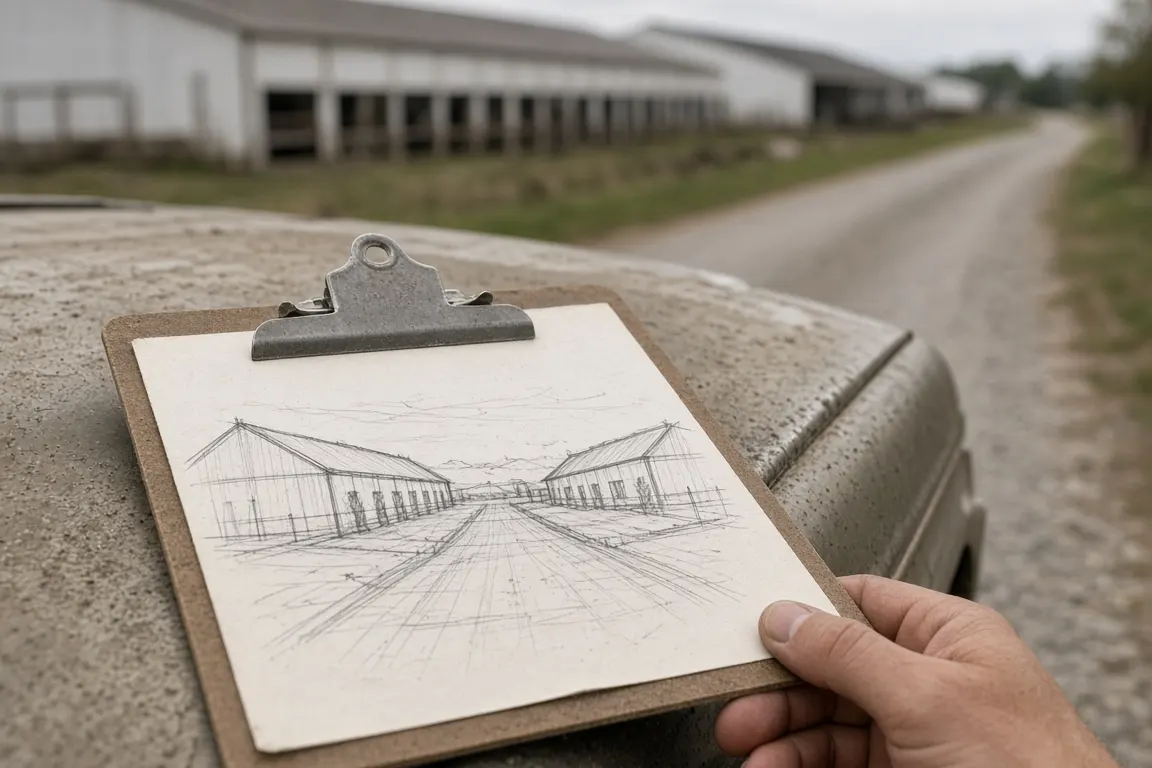
For each likely event, write down a first choice and a fallback. Mark on a farm map the spot you'd use for on-site composting or burial if it were allowed. It should be high and dry, away from wells and streams, reachable by a loader in wet weather and out of sight of the road if you can manage it. USDA APHIS disposal guidance puts compost sites at least 300 feet from bodies of water, and large-animal trenches typically run 4-8 ft deep[7].
If you lost a lot of animals at once, what would worry you most?
Tap an answer to vote and see how others answered. Anonymous.
Doing the math
How much space, carbon and equipment would you need?
This is where most plans go vague, and where the numbers matter most. Composting cattle takes a lot of cover material: roughly 10-12 cu yd per 1,000 lb[8] of carcass. By our estimate, a single 1,400 lb Holstein needs about 14 to 16.8 cubic yards[9]. Ten of them need a small mountain of wood chips, sawdust or old bedding, and you won't find that on short notice in a disaster week.
| Loss | Approximate carcass weight | Cover material to plan for |
|---|---|---|
| 1 mature dairy cow | 1,400 lb | 14 to 17 cubic yards |
| 10 feedlot steers | 12,000 lb | 120 to 145 cubic yards |
| 40 newborn calves after a storm | 3,200 lb | 32 to 40 cubic yards |
| 200 finishing hogs | 50,000 lb | 500 to 600 cubic yards |
Write down where that material would come from: a sawmill, a tree service, a neighbor's bedding pack. Note how many semi-loads it represents and whether you'd need a permit to receive it. Do the same for equipment. A skid steer handles calves and pigs; mature cattle usually need a loader with a bucket or forks, or a hauler with a winch.

Free tool
Livestock mortality planner
Plan disposal capacity and costs for farm losses, from one animal to a herd.
The livestock mortality planner does this arithmetic for any species, head count and method, and gives a cost range you can drop straight into the plan. For a full walk-through of building a pile, see our step-by-step composting guide.
People and phone numbers
Who makes the call, and who do they phone?
Name one person who decides how dead animals leave the farm, and one backup for when they're away. Crews do what the loudest voice tells them in a crisis, so the plan should say clearly who that voice is. Put the contacts on one page, in this order:
- Herd or flock veterinarian, including their after-hours number.
- State veterinarian's office and the local USDA field office, for anything that looks like a reportable disease.
- Primary disposal vendor and the backup you priced.
- Carbon material source and an excavator or custom operator with a loader.
- Integrator or processor contact, if you raise under contract.
- Insurance agent, since many policies need photos and a count before disposal.
Then decide what triggers a call to the vet before anyone moves a carcass: several animals down at once, sudden deaths with no obvious cause, neurological signs or bleeding. Respiratory disease is the most common non-predator cause of adult cattle death at 23.9%[10], but unexplained deaths are close behind, and those are the ones a lab may need to see. Our staff briefing guide covers how to get that message across to a crew.
Keeping it off the farm
How does the plan protect the living animals?
Dead animals are a biosecurity problem. They draw scavengers, and the trucks that collect them visit many farms in a day. After bird flu detections, USDA audits most often called for fixes in mortality handling, wildlife access and visitor records[11]. Your plan should say where the truck stops, which lanes it never uses and how the pickup point is cleaned.
The dead-stock pad belongs at the edge of the farm, not at the heart of it.
If you use a hauler, interview them on this before you sign anything. Our biosecurity and capacity interview guide has the questions and what a solid answer sounds like.
Making it stick
How do you keep the plan current?
Plans die in binders. Print the one-page contact sheet and tape it inside the shop door and the office. Review it every year before your riskiest season, whether that's summer heat for a feedlot or spring migration for a layer house. Update it whenever a vendor changes, a building goes up or a key person leaves.
Walk the route once with the person who would run it. Can a loaded truck get through the gate in March mud? Does the backup excavator still answer the phone? The planning hub has printable checklists, and if you'd like help finding vendors that cover your county, tell us about your operation. We don't haul or process anything ourselves, but we can do the legwork of finding who does. Our services page describes each route, the locations pages cover state rules, and the reader poll results show how other operations answer the same planning questions.
Do you have a written plan for a big loss, like a blizzard, heat wave or disease outbreak?
Tap an answer to vote and see how others answered. Anonymous.

Reader polls
What would you choose?
Vote anonymously and see how other readers answered. The results are live counts from people who visit this site, so they show real opinions, not a scientific sample.
Do you have a written plan for a big loss, like a blizzard, heat wave or disease outbreak?
Tap an answer to vote and see how others answered. Anonymous.
If you lost a lot of animals at once, what would worry you most?
Tap an answer to vote and see how others answered. Anonymous.
Would you pre-pay for aftercare while your pet is still healthy?
Tap an answer to vote and see how others answered. Anonymous.


Questions people ask
Is a livestock mortality plan required by law?
It depends on your state, species and size. Many large permitted livestock operations must describe how they handle dead animals as part of their nutrient management or operating permit, and poultry integrators often require one. Even where nothing is required, lenders, insurers and animal health officials ask for it after a large loss, so it pays to have one.
How much cover material does it take to compost a dead cow?
Extension guidance calls for roughly 10 to 12 cubic yards of wood chips, sawdust or similar carbon material per 1,000 lb of carcass. A mature dairy cow therefore needs around 14 to 17 cubic yards, including a base layer and a thick cap. Wet bedding or manure can make up part of it, but the pile needs dry material to heat properly.
What should I do first if many animals die at once?
Keep people and remaining animals safe, then call your veterinarian before moving carcasses, especially if there's no obvious cause like a storm or fire. Take photos and a count for insurance. Don't bury or burn anything until you know whether a reportable disease is possible, because officials may need samples and will direct disposal.
Can I burn dead livestock on the farm?
Open burning of carcasses is illegal in many states. Pennsylvania, for example, lists only composting, rendering, incineration and burial as legal methods. Burning in the open rarely consumes a large carcass fully and can draw complaints. Approved incinerators are a different thing, and some farms own one for poultry or pigs.
Who pays for disposal if animals are depopulated for disease?
In US federal responses to diseases such as avian influenza, USDA has paid indemnity for destroyed animals and covered some approved cleaning and disposal costs, usually tied to a flock plan and documented biosecurity. Terms change between outbreaks, so ask the incident team what's eligible before you spend money.
How often should a farm mortality plan be updated?
Review it once a year at minimum, ideally just before your riskiest season. Update it right away when a vendor changes, a building is added, the herd grows significantly or the person in charge changes. A plan with a disconnected phone number is worse than no plan, because people trust it.


Sources and our estimates
- [1] About 10,630 U.S. cattle and calves died every day in 2015. Our estimate: 3,880,000 / 365. How we calculate.
- [2] U.S. adult cattle death loss was 2.2% of inventory and calf death loss was 6.2% of the calf crop in 2015. USDA APHIS NAHMS - Death Loss in U.S. Cattle and Calves Due to Predator and Nonpredator Causes, 2015 (published Dec 2017), 2015.
- [3] Dairy operations had a 3.1% adult cattle death loss rate in 2015, compared with 1.8% on beef operations. USDA APHIS NAHMS - Death Loss in U.S. Cattle and Calves Due to Predator and Nonpredator Causes, 2015 (published Dec 2017), 2015.
- [4] Pennsylvania requires a dead domestic animal to be properly disposed of within 48 hours of death. Penn State Extension - Livestock and Poultry Mortality Disposal in Pennsylvania (J. Craig Williams, updated Oct 2025), 2025.
- [5] As of September 30, 2025, the U.S. highly pathogenic avian influenza (HPAI) outbreak that began in February 2022 had hit all 50 states and Puerto Rico, infecting 1,741 premises and affecting over 179 million birds. USDA APHIS CEAH - Status and Epidemiologic Analyses of HPAI-affected Poultry Flocks, September 30, 2025 Interim Report, 2025.
- [6] Composting was used for 85% of poultry carcasses in the 2014-2015 U.S. HPAI outbreak; EPA lists composting and permitted landfills as the preferred disposal methods. U.S. EPA - Carcass Management During Avian Influenza Outbreaks, 2015.
- [7] Mass-burial trenches for large animals are typically 4-8 feet deep and about 6 feet wide, and compost sites should be at least 300 feet from bodies of water. USDA APHIS / Center for Food Security and Public Health (Iowa State) - Disposal: Composting, Rendering & Burial handout, based on NAHEMS Disposal Guidelines (2012), 2012.
- [8] Bovine composting may require 10-12 cubic yards of cover material per 1,000 lb of carcass. USDA APHIS / Center for Food Security and Public Health (Iowa State) - Disposal: Composting, Rendering & Burial handout, based on NAHEMS Disposal Guidelines (2012), 2012.
- [9] Composting a 1,400 lb dairy cow would need roughly 14-16.8 cubic yards of cover material. Our estimate: 1.4 x (10 to 12 cu yd per 1,000 lb). How we calculate.
- [10] Respiratory problems were the leading nonpredator cause of adult cattle deaths (23.9%), followed by unknown causes (14.0%) and old age (11.8%). USDA APHIS NAHMS - Death Loss in U.S. Cattle and Calves Due to Predator and Nonpredator Causes, 2015 (published Dec 2017), 2015.
- [11] USDA biosecurity audits after HPAI detections most commonly required fixes related to mortality management (dead-bird handling), wildlife access and visitor records. USDA APHIS CEAH - Status and Epidemiologic Analyses of HPAI-affected Poultry Flocks, September 30, 2025 Interim Report, 2025.
Get help lining up mortality vendors
Tell us what you need and where you are. We'll reply by email with clear options and prices so you can decide in your own time.