Livestock mortality composting, step by step
Lay a two-foot bed of wood chips or sawdust, set the carcass on it, cover it with two more feet of carbon, and let the pile reach 135-140 F[1] within about two weeks. Leave it, turn it once, and give it a few months for big animals.
By the Livestock Cremation Services editorial team · Updated September 24, 2026 · 5 min read · Sources
- Carbon amounts for cattle, pigs, sheep and poultry
- Temperatures and timing you can check with a probe
- Fixes for smell, scavengers and leftover bones
The short answer
Does composting a dead animal really work?
Yes, and it's one of the methods extension services and animal health agencies lean on hardest. In the 2014 to 2015 bird flu outbreak, about 85%[2] of affected poultry carcasses were composted, according to the EPA's avian influenza carcass guidance, much of it on the farms where the birds died. Done right, a mortality pile doesn't smell, doesn't draw coyotes, and turns a cow into a heap of dark, crumbly material and a few softened bones.
Done wrong, it's a stinking mound that the dogs dig into. The difference is almost entirely in three things: enough carbon, enough cover and patience. This article walks through each, species by species. If you're still weighing composting against the other routes, start with our overview of how to dispose of a dead cow.
Step 1
Where should the compost pile go?
Pick a spot that's high and well drained, with a slight slope so rain runs off rather than pooling. Keep it at least 300 feet from streams, ponds and wells, and farther if your state says so. You want year-round access for a loader, and ideally a place out of sight of the road and downwind of the house. Rules on setbacks differ by state, and our locations directory shows what applies where you farm.
- Base: compacted soil, clay or a concrete pad. Avoid gravel or sand that lets liquid straight through.
- Size: for a single cow, a patch roughly 12 by 12 feet. For a windrow, a strip 12 to 15 feet wide and as long as the loss needs.
- Distance from animals: away from pens and lanes, so healthy stock and feed trucks don't pass it.
- Bins: for poultry, calves, lambs and pigs, three-sided bins of lumber or concrete blocks make it tidy and routine.
Step 2
How much carbon material do you need?
More than you think. Cattle need roughly 10-12 cu yd per 1,000 lb[3] of carcass, counting the base and the cap. By our estimate, a 1,400 lb dairy cow therefore takes about 14 to 16.8 cubic yards[4], which is two to three loaded dump-truck beds. Smaller animals need less in total but still need a full base and cover.
| Animal | Typical weight | Carbon to have on hand |
|---|---|---|
| Mature beef cow | 1,200 lb | 12 to 15 cubic yards |
| Market hog | 280 lb | 3 to 4 cubic yards |
| Ewe | 160 lb | 2 to 3 cubic yards (a full base and cap is the real minimum) |
| Day's losses in a broiler house | 100 lb of birds | Layered into a bin with sawdust or litter |
Wood chips make the base, because they let air in and soak up liquid. Sawdust, shavings, old hay, straw and used bedding work for cover. Manure-heavy bedding can be part of the mix but the pile needs dry, woody material to breathe. The livestock mortality planner works out the volume for any head count and weight.

Free tool
Livestock mortality planner
Plan disposal capacity and costs for farm losses, from one animal to a herd.
Step 3
How do you build the pile around a carcass?
- Lay the base. Spread 18 to 24 inches of wood chips or coarse material, wider than the animal by two feet on every side.
- Place the carcass. Set it on its side in the middle of the base, legs toward the center if you're adding more than one.
- Vent the rumen. For cattle, sheep and goats, open the rumen with a knife so gas can escape. Otherwise the carcass can bloat and burst the pile open. Wear gloves and eye protection.
- Add moisture if it's dry. A little water or fresh manure over the carcass helps the microbes get going.
- Cover completely. Pile at least two feet of carbon over every part of the animal, including legs and head. Nothing should poke through.
- Mark it. A post with the date and animal ID saves guesswork in six months.
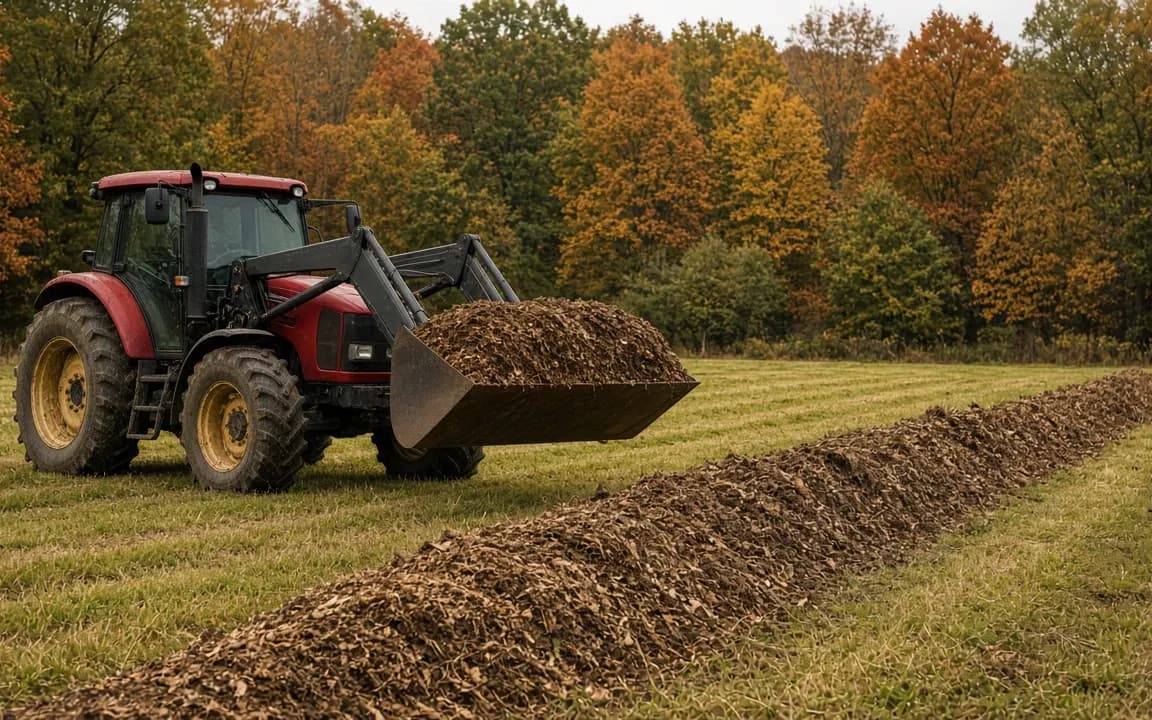
For several animals, build a windrow: a long base, carcasses laid side by side a foot or so apart, then cover. Large losses need a lot of room, which is why our barn and feedlot planning guide suggests marking the site before you need it.
Step 4
How hot should it get, and how long does it take?
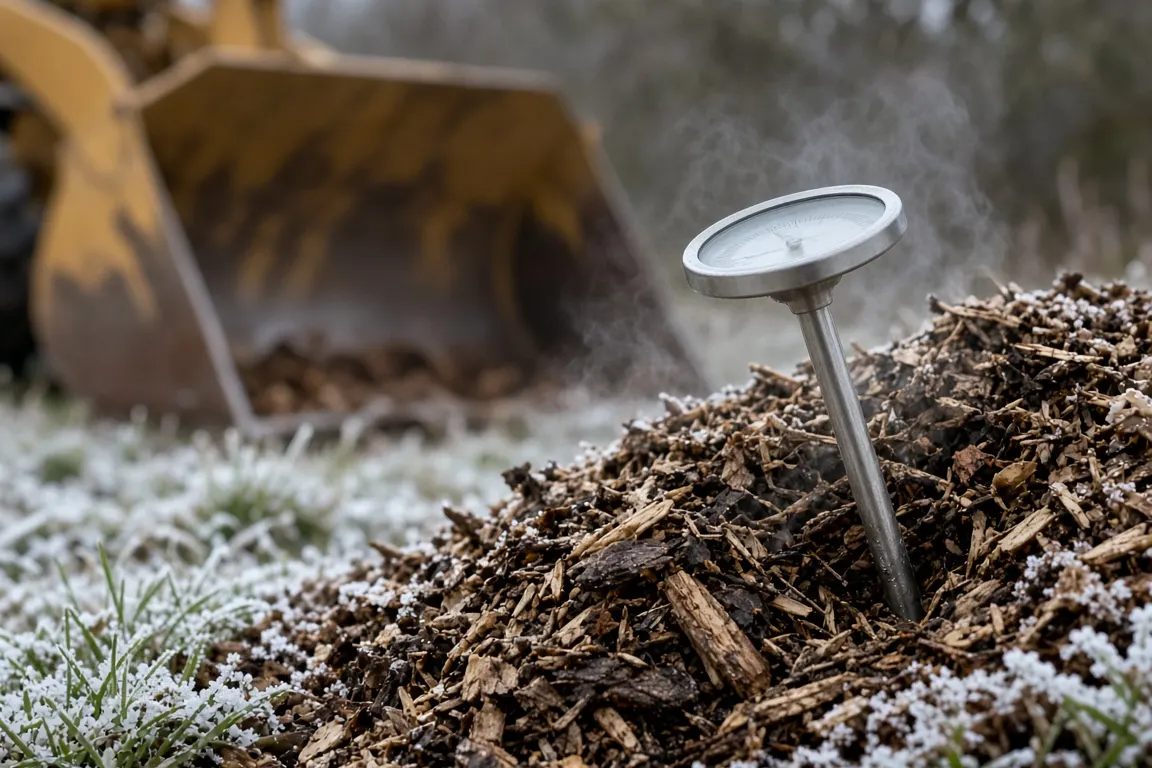
Check the temperature with a long probe thermometer pushed into the core. USDA APHIS disposal guidance says a carcass pile should reach 135-140 F[1] within about 15 days and stay hot for three to twelve weeks. That heat is what kills most pathogens and weed seeds, and it's a sign the pile is breaking down, not just sitting there.
After that first hot phase, turn the pile with a loader to mix in air and start a second phase. That second phase is where size really shows. It takes about ten days for chickens but roughly 240 days[5] for mature cows and horses. An intact horse, for comparison, takes 9-10 months[6] overall.
| Stage | Poultry and small stock | Adult cattle |
|---|---|---|
| Pile heats to 135°F+ | Within a week | Within about two weeks |
| Primary (hot) phase | A few weeks | Three months or more |
| Turn and restart | Once | Once, sometimes twice |
| Secondary phase | About 10 days | Around eight months |
| Usable compost | Within a couple of months | Often close to a year |
When it goes wrong
Why does a compost pile smell or attract scavengers?
- Smell: not enough cover, too wet, or a carcass showing. Add a thick layer of dry carbon on top.
- Digging by dogs or coyotes: thin cover. Two feet is the minimum; add more around the edges.
- Pile won't heat: too dry, too cold, or too much sawdust packed tight. Add moisture and coarser material, and give it time in winter.
- Liquid seeping out: base too thin. Add absorbent material around the downhill side and thicken the base next time.
- Bones left at the end: normal with cattle. Put them in the next pile's base; they soften further.
Have you ever composted a mature cow, steer or horse?
Tap an answer to vote and see how others answered. Anonymous.
If you can smell it, it needs more cover. That rule solves most compost problems.
The money
What does it cost to compost one large animal?
A New York study priced composting a 1,200 lb horse at $170-$380[7] for materials, equipment, fuel and labor, which makes a fair benchmark for a mature cow. If you already have wood chips and a loader, your cash cost can be far lower. For a comparison with rendering and burial, see our breakdown of dead livestock removal costs. Whether other farms have composted a mature animal is one of our reader poll questions, and the tallies so far are worth a look.
Composting is a practical route for production losses. It isn't the route for a family cow or a show steer whose ashes you'd like to keep, which only private cremation can offer. Our services page covers both, and if you need a custom compost operator or a backup route in your county, send us the details.

Reader polls
What would you choose?
Vote anonymously and see how other readers answered. The results are live counts from people who visit this site, so they show real opinions, not a scientific sample.
Have you ever composted a mature cow, steer or horse?
Tap an answer to vote and see how others answered. Anonymous.
When an adult animal dies on your place, what usually happens to it?
Tap an answer to vote and see how others answered. Anonymous.
If you had to decide today, which aftercare would you choose for your pet?
Tap an answer to vote and see how others answered. Anonymous.


Questions people ask
How long does it take to compost a dead cow?
Plan on roughly a year from start to finished compost for a mature cow. The pile should heat up within about two weeks and stay hot for several months, then be turned for a second phase that can run about 240 days. Calves and small animals are much quicker.
Do you need to cut up a carcass to compost it?
No. Large animals are composted whole, but the rumen of cattle, sheep and goats should be opened so gas can escape and the carcass doesn't bloat and burst through the cover. Some operators also open the chest cavity to speed things up, but that isn't necessary for a good result.
Which carbon material works well for composting livestock?
Coarse wood chips make an ideal base because they let air in and absorb liquid. For cover, sawdust, shavings, chopped straw, old hay and used bedding all work. A mix of coarse and fine material usually heats better than sawdust alone, which can pack too tightly.
Can you compost livestock in winter?
Yes, although piles heat more slowly in hard cold. Build the base before the ground freezes if you can, use a thicker cap and keep carbon material dry under a tarp. Once a pile is working it generates its own heat and will keep going through most northern winters.
Is compost from dead animals safe to spread on fields?
Properly finished compost that reached pathogen-killing temperatures is generally spread on cropland or pasture, but pick out any remaining large bones and follow your state's rules. Don't spread it on land that grows crops eaten raw, and keep animals that died of reportable disease out of it unless officials approve.


Sources and our estimates
- [1] A carcass compost pile should reach 135-140 F within 15 days and be held at temperature for 3-12 weeks. USDA APHIS / Center for Food Security and Public Health (Iowa State) - Disposal: Composting, Rendering & Burial handout, based on NAHEMS Disposal Guidelines (2012), 2012.
- [2] Composting was used for 85% of poultry carcasses in the 2014-2015 U.S. HPAI outbreak; EPA lists composting and permitted landfills as the preferred disposal methods. U.S. EPA - Carcass Management During Avian Influenza Outbreaks, 2015.
- [3] Bovine composting may require 10-12 cubic yards of cover material per 1,000 lb of carcass. USDA APHIS / Center for Food Security and Public Health (Iowa State) - Disposal: Composting, Rendering & Burial handout, based on NAHEMS Disposal Guidelines (2012), 2012.
- [4] Composting a 1,400 lb dairy cow would need roughly 14-16.8 cubic yards of cover material. Our estimate: 1.4 x (10 to 12 cu yd per 1,000 lb). How we calculate.
- [5] The second composting phase takes about 10 days for chickens but approximately 240 days for mature cows and horses. USDA APHIS / Center for Food Security and Public Health (Iowa State) - Disposal: Composting, Rendering & Burial handout, based on NAHEMS Disposal Guidelines (2012), 2012.
- [6] An intact horse carcass takes approximately 9-10 months to compost, and piles should reach at least 130 F. Extension Horses (eXtension national Cooperative Extension) - Horse Disposal Options, 2019, 2019.
- [7] Composting a 1,200-pound horse requires about 10 cubic yards of carbon material (wood chips, sawdust), and total material, equipment, fuel and labor costs were estimated at $170-$380 per horse. Cornell Waste Management Institute & Penn State - Horse Mortality: Carcass Disposal Alternatives (2012), 2012.
Find a compost operator or backup route
Tell us what you need and where you are. We'll reply by email with clear options and prices so you can decide in your own time.