What records should you keep when livestock die?
Log every death on the day it happens: animal ID, date, weight class, likely cause, where the carcass went and the ticket that proves it. With the average dead cow or calf worth about $997 per head[1] in 2015, those lines are often what an insurer, auditor or vet asks for first.
By the Livestock Cremation Services editorial team · Updated September 24, 2026 · 5 min read · Sources
- A simple log that works for 10 head or 10,000
- Why the hauler's ticket isn't the whole record
- What insurers, auditors and vets usually ask for

The short answer
Why do mortality records matter so much?
A death record does three jobs. It proves the carcass was handled legally, it gives your vet a pattern to look at when losses creep up, and it backs up any claim for insurance, indemnity or a tax write-off. Farms that keep a clean log rarely think about it. Farms that don't usually find out after a big loss, when someone asks for a count and there isn't one.
The money involved is not small. USDA's 2015 cattle and calf death-loss report estimated that death loss cost US producers $3.87 billion[2] that year, and by our estimate Texas alone was losing cattle and calves at about 1,452 per day[3]. Each of those animals had a value, and each one left the farm by some route that a regulator could ask about.
This guide is for operations that lose animals regularly: dairies, feedlots, cow-calf outfits, hog and poultry barns, sheep and goat flocks. It pairs with our mortality pre-planning guide, which covers where carcasses go in the first place.
The log itself
What should each death record include?
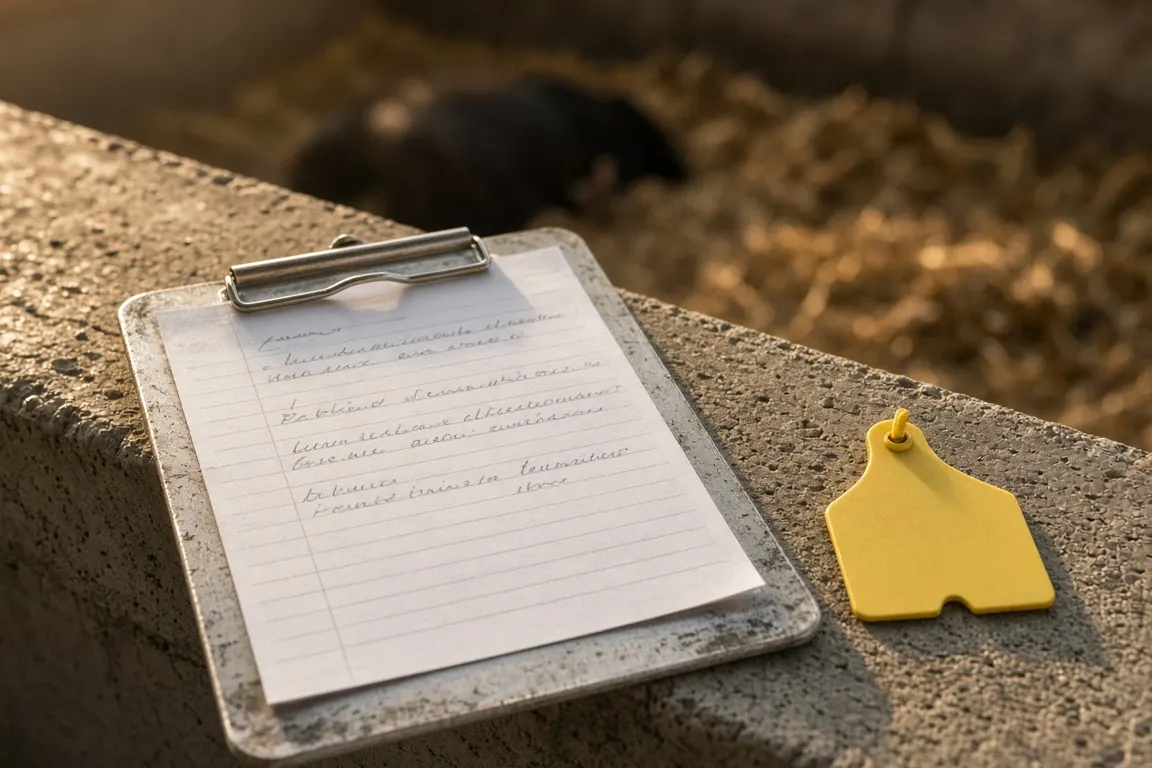
Keep one line per animal for cattle, horses and other large stock, and one line per pen, house or event for poultry and pigs. The fields below cover what almost anyone will ask for:
| Field | Example | Why it matters |
|---|---|---|
| Date and time found | 3 March, 6:15 a.m. | Shows you met your state's disposal deadline |
| Animal or group ID | Tag 4417, or Barn 3 pen 12 | Links the death to inventory and treatment records |
| Species, class, weight | Holstein cow, about 1,450 lb | Drives disposal cost and compost sizing |
| Observed signs and likely cause | Down, bloated, no prior treatment | Lets the vet spot patterns and reportable disease |
| Euthanized? Method? | Yes, by vet, barbiturate | Some renderers refuse drug-euthanized animals |
| Samples taken | Tissue sent to state lab | Proves a diagnosis was pursued |
| Disposal route and location | Rendering, pickup at road pad | Shows a legal method was used |
| Ticket or record number | Hauler ticket 20931 | Ties your log to a third-party document |
| Recorded by | Initials | Someone can answer questions later |
A spiral notebook in the shop works if it's filled in every time. Many operations now use a herd app or a shared spreadsheet so the office sees the same numbers as the barn. The format matters less than the habit.
A common gap
Is the renderer's receipt enough on its own?
Usually not. A hauler's ticket proves that something was collected and a fee was charged. It often doesn't list which animals, why they died or whether any were euthanized with drugs. If an auditor or insurer asks about tag 4417, the ticket alone may not answer the question.
The fix is simple: write the ticket number on your log line, and ask the vendor whether they can record head count and weight on every pickup. Good vendors already do. Our biosecurity and capacity interview guide includes paperwork questions to ask before you sign a contract.
Using the numbers
How can records help you lose fewer animals?
The log is also a management tool. Across US cattle, respiratory problems led non-predator adult deaths at 23.9%[4], followed by unknown causes at 14.0%. A farm with a high share of "unknown" on its own log has a clear next step: more necropsies. A spike in one pen, one month or one supplier of calves shows up on paper before anyone notices it in the barn.
- Add up deaths by month and by cause every quarter and share them with your vet.
- Compare your death loss rate with your own past years, not just with national averages.
- Flag any cluster of sudden deaths within a few days for an immediate call, not a quarterly review.
- Track disposal cost per head, so you can compare routes honestly when a contract comes up for renewal.
When an adult animal dies on your place, what usually happens to it?
Tap an answer to vote and see how others answered. Anonymous.
If you want to test what a route change would cost, the livestock mortality planner turns your yearly losses into cost, compost volume or pit size. Our article on rendering vs burial costs compares the routes per head, and our reader poll results show how other operations handle routine deaths.

Free tool
Livestock mortality planner
Plan disposal capacity and costs for farm losses, from one animal to a herd.
When it's more than one
What extra records does a mass-loss event need?
A storm, fire or disease response adds layers. Before anything is moved, count and photograph the animals, note which buildings or pastures they came from and write down the time you found them. Then record every instruction you receive, who gave it and when. Official responses can change direction within a day, and you'll want to show you followed the version in force at the time.
Disease events bring their own paperwork. In the bird flu responses, USDA biosecurity audits after detections most often asked for fixes around dead-bird handling, wildlife access and visitor logs[5]. Keep your visitor log, your mortality log and your cleaning records together, because they are often reviewed as a set.
Write down who told you to do what, and when. In a fast-moving response, that line protects everyone.
Crews need to know what to record as well. Our staff briefing guide covers who keeps the log during an event and how to hand it over between shifts.
Not every animal is a number
What about a show animal or a family cow on a commercial farm?
Even big operations have animals that matter more than their tag value: the old cow the kids named, a champion show heifer, the working dog's favorite goat. If one of them dies and the family wants a private cremation with the ashes back, pull that animal off the normal dead-stock route before the truck comes. Log it the same way, but note the separate route and the crematory's certificate.
Our article on what to do when a show animal dies explains the private route, and our services overview lists every option side by side. If you need a provider that can handle a mature animal, send us the details and we'll email options that serve your area.

Reader polls
What would you choose?
Vote anonymously and see how other readers answered. The results are live counts from people who visit this site, so they show real opinions, not a scientific sample.
When an adult animal dies on your place, what usually happens to it?
Tap an answer to vote and see how others answered. Anonymous.
Do you have a written plan for a big loss, like a blizzard, heat wave or disease outbreak?
Tap an answer to vote and see how others answered. Anonymous.
Did you (or would you) compare more than one provider?
Tap an answer to vote and see how others answered. Anonymous.

Questions people ask
How long should I keep livestock mortality records?
Keep them at least as long as your state, permit, integrator contract or tax records require, which often means three to five years. Many producers keep them longer because they're useful for tracking herd health over time. If you have a nutrient management or operating permit, check its record-keeping clause, since it may set a specific period.
Do I need records for a single dead calf?
Yes, it's worth logging every death, including calves. Calf losses ran at 6.2% of the US calf crop in 2015, far higher than adult losses, and they're often where management problems show up first. A single line takes a minute and makes the yearly totals meaningful.
Can dead livestock be written off for taxes?
Tax treatment depends on whether the animal was raised or purchased, whether it was held for sale or breeding, and your accounting method. Raised animals often have no cost basis to deduct, while purchased breeding stock may. Talk to an agricultural tax preparer and give them your death log and disposal receipts.
What paperwork should a rendering company give me?
At minimum, a dated ticket with your farm name, the pickup location and the charge. Ask whether they can add head count, species and estimated weight on every ticket. For contracts, ask for a monthly statement you can reconcile against your own log, and confirm how they record animals they refuse to take.
Should euthanized animals be recorded differently?
Record who performed the euthanasia and the method. Carcasses euthanized with barbiturates carry drug residues, and some renderers won't accept them, while the FDA requires label warnings that such carcasses be disposed of so wildlife can't feed on them. The note helps the next person choose a legal route.


Sources and our estimates
- [1] The average value lost per dead cow or calf in 2015 was about $997. Our estimate: $3.87 billion / 3.88 million head. How we calculate.
- [2] Death loss in U.S. cattle and calves in 2015 was estimated to cost producers $3.87 billion. USDA APHIS NAHMS - Death Loss in U.S. Cattle and Calves Due to Predator and Nonpredator Causes, 2015 (published Dec 2017), 2015.
- [3] Texas lost about 1,452 cattle and calves per day in 2015. Our estimate: (310,000 + 220,000) / 365. How we calculate.
- [4] Respiratory problems were the leading nonpredator cause of adult cattle deaths (23.9%), followed by unknown causes (14.0%) and old age (11.8%). USDA APHIS NAHMS - Death Loss in U.S. Cattle and Calves Due to Predator and Nonpredator Causes, 2015 (published Dec 2017), 2015.
- [5] USDA biosecurity audits after HPAI detections most commonly required fixes related to mortality management (dead-bird handling), wildlife access and visitor records. USDA APHIS CEAH - Status and Epidemiologic Analyses of HPAI-affected Poultry Flocks, September 30, 2025 Interim Report, 2025.
Find a disposal vendor that documents pickups
Tell us what you need and where you are. We'll reply by email with clear options and prices so you can decide in your own time.