What size urn does a show steer or lamb need?
A standard adult urn holds around 200 cubic inches, but a 1,300 lb steer needs about seven times that. Enter the weight and see the volume, the urn size and the keepsake options.
- Volume in cubic inches and liters
- Split between a main urn and keepsakes
- Ideas for very large amounts of ashes
Urn size calculator
Enter your pet's healthy adult weight. We size the urn using the industry rule of 1 cubic inch per pound, plus 10% room to spare.
Recommended urn size
1,430 cu in (23,433 mL)
Look for: Large-animal urn, chest or several urns
| Total ashes (by volume) | 1,300 cu in (21,303 mL) |
|---|---|
| Expected ash weight | 39 lb–65 lb |
| Urn with 10% margin | 1,430 cu in (23,433 mL) |
Standard sizes: small up to 20, medium up to 60, large up to 120 and extra large 200+ cubic inches. If you're between sizes, choose the larger one.
Source: Embrace Pet Insurance - Bury or Cremate Your Dog? Costs, Pros & Cons; Our estimate. 1 cu in per lb is an industry rule of thumb
Next step: Find urns and prices near you →
Using the calculator
Three inputs: weight, sharing and keepsakes
- Enter the animal's weight in pounds or kilograms. Last show weight or sale-barn weight is fine.
- Choose how many people will share the ashes, from one to eight. The calculator divides the total between them.
- Tick keepsakes if each person would like a keepsake urn of about 3 cubic inches alongside the main container.
You'll see the main urn volume in cubic inches and milliliters, a suggested size band, the expected ash weight and how much goes to keepsakes. Change the inputs and it updates immediately.
The rule
The one-cubic-inch-per-pound rule, and why it works
Urn makers size containers with a simple rule: about one cubic inch of space for every pound of live body weight. The calculator adds a 10% margin so the lid closes comfortably. The rule works because cremated remains weigh roughly 3-5% of body weight[1] and pack at a fairly consistent density.
Standard urn sizes are built around pets and people: small around 20 cubic inches, medium 60, large 120 and extra-large 200 or more. Anything much over 200 lb of body weight moves beyond off-the-shelf sizes, which is where livestock families need a different approach.
3-5% of body weight[1]
Embrace notes cremated remains typically weigh about 3-5% of the pet's original body weight.
38.5 lb[2]
A 1,100 lb horse would be expected to return roughly 38.5 lb of cremated remains (plausible range 33-55 lb).
USD 50–1,000+[3]
Personalized pet urns range from about USD 50 to more than USD 1,000.
Worked example
Worked example: a 1,300 lb show steer shared by four
At one cubic inch per pound plus 10%, a 1,300 lb steer needs about 1,430 cubic inches, roughly 23 liters or six gallons. That's the size of a small cooler. By our estimate, the ashes themselves should weigh somewhere around 39 to 65 lb, in line with the 38.5 lb[2] we calculate for a 1,100 lb animal.
| Portion | Container | Volume |
|---|---|---|
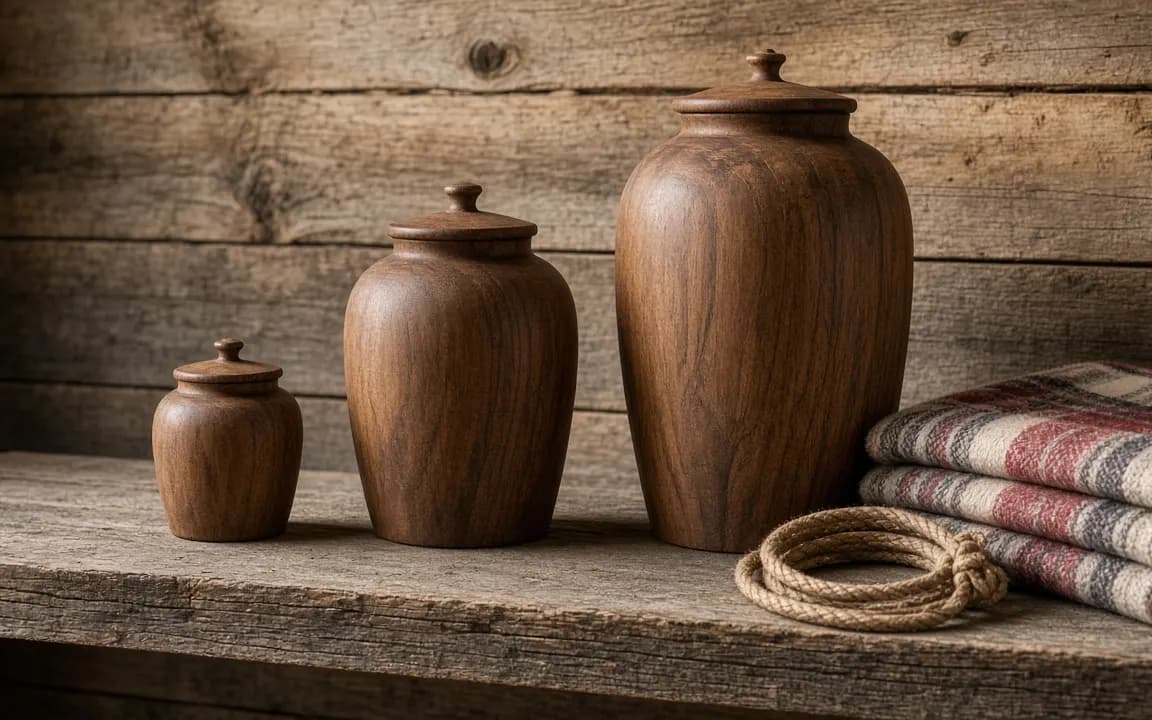
| Family urn for the house | Extra-large wooden urn | About 200 cu in |
| The child who showed him | Keepsake urn plus a pendant | About 3 cu in plus a pinch |
| Grandparents | Medium urn | About 60 cu in |
| Uncle who hauled him to shows | Small urn | About 20 cu in |
| Scattered or buried on the farm | Temporary box or bag | About 1,150 cu in |
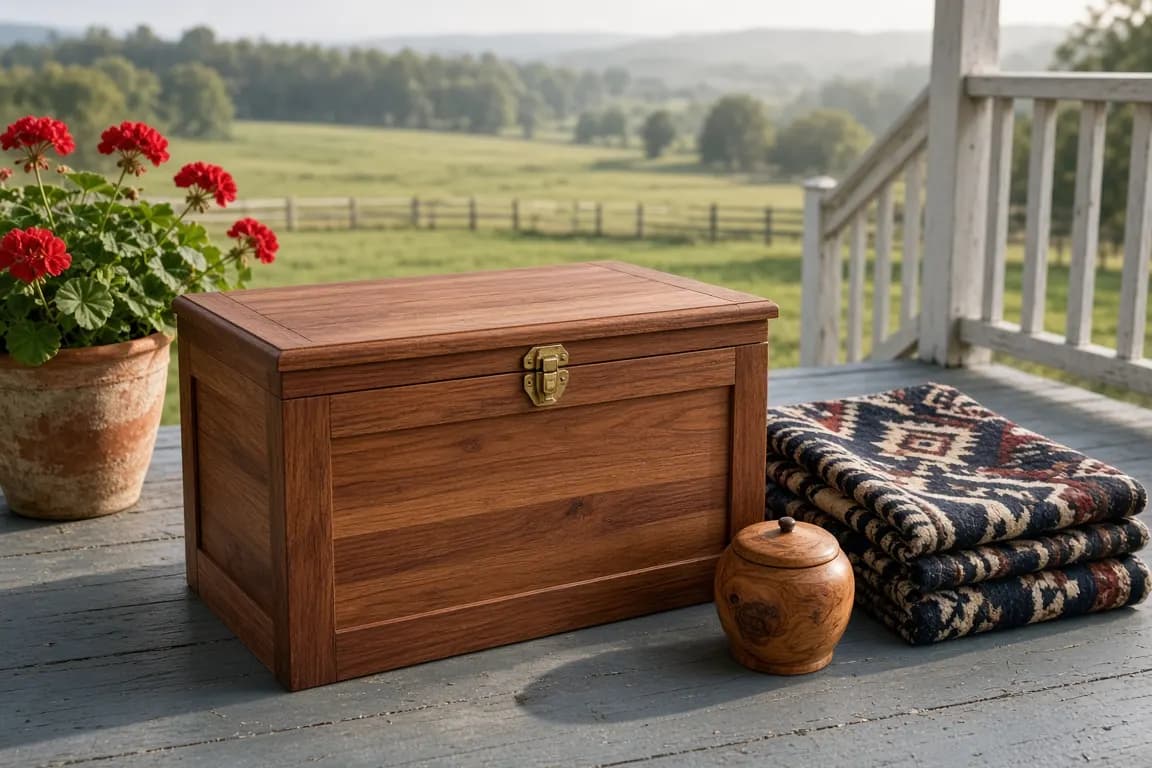
The calculator itself splits evenly: set sharing to four and it suggests about 358 cubic inches (5,858 mL) per person, so an uneven plan like this one is worked out on paper from the 1,430 total. Most of the volume ends up outside an urn, and that's normal for a large animal. If you'd rather keep more of it, a lidded cedar chest or a custom box from old barn boards can hold the lot. The ashes weight estimator shows the weight you'll be handling.
Smaller show animals
Lambs, goats and pigs fit standard urns
For smaller show animals, standard sizes work. A 90 lb market goat needs about 99 cubic inches, a large urn. A 140 lb lamb needs about 155, so an extra-large urn fits with room. A 280 lb show pig needs around 310 cubic inches, which means either a bigger custom urn or a main urn plus a scattering.
Prices vary more than volumes. One industry report puts personalized pet urns at about USD 50–1,000+[3], and engraving the animal's name, show number or ear tag number is common. The memorial budget planner adds the urn to the rest of the costs.
Families with a heifer that went on to calve, or an old ewe that raised a dozen lambs, sometimes choose a shared urn for the animal and her first offspring later on. If that's likely, size the container for both now, or pick a style you'll be able to match in a larger size. The reader poll results show what other show families say they would want back.
If a show steer, heifer or lamb your family raised died at home, what would you want?
Tap an answer to vote and see how others answered. Anonymous.
Beyond the urn
Burying or planting the ashes on the farm
Many families bury part of a large animal's ashes under a tree near the barn or at the edge of the pasture where it grazed. Because the remains are very alkaline, gardeners usually suggest mixing them with soil and compost and waiting 90–120 days[4] before planting directly into the mix.
Biodegradable urns designed for planting come in sizes meant for pets, so for a steer you'd typically plant only a portion. For ideas that go easy on the land, see our guide to environmental claims in livestock aftercare. If you'd rather bury the whole animal, our locations pages cover burial rules by state.
Know the limits
What the calculator can't tell you, and what to do next
The volume is an estimate. Heavy-boned animals may need a little more space, well-finished market animals a little less. The calculator also can't tell you how the provider will return the ashes; for large animals they often come in a heavy bag inside a box, and you transfer them yourself.
It's also worth asking how long the return takes. A large animal needs a long burn and a long cool-down, and the provider may need time to process and bag that much material. These chambers run very hot; GOV.UK's rules for animal incinerators, for example, require exhaust gases to be held at 850°C or more. Our guide to what happens during livestock cremation walks through each stage, so the wait makes sense and you can have the right container ready when the ashes come home.
Before ordering anything, confirm the cremation is private and ask how the ashes will come back. For a sense of scale, the equine extension network reports $600 to $1,000 to cremate a 1,000 lb horse. Our cremation cost calculator prices the cremation, our services page lists every route, and if you'd like help finding a provider, send us the details.
Free tool
Ashes weight estimator
See roughly how much ash to expect back, by species and body weight.

Reader polls
What would you choose?
Vote anonymously and see how other readers answered. The results are live counts from people who visit this site, so they show real opinions, not a scientific sample.
If a show steer, heifer or lamb your family raised died at home, what would you want?
Tap an answer to vote and see how others answered. Anonymous.
Which memorial feels most like your pet?
Tap an answer to vote and see how others answered. Anonymous.
What personal touch matters most on a memorial?
Tap an answer to vote and see how others answered. Anonymous.


Questions people ask
Can I buy an urn big enough for a whole cow?
Rarely off the shelf. A 1,300 lb animal needs around 1,400 cubic inches, far beyond standard urn sizes. Families usually use a custom wooden chest, a large memorial box, or split the ashes between several urns and a scattering. A local woodworker can often build something from the animal's own barn.
What size urn does a lamb need?
A 140 lb market lamb needs roughly 155 cubic inches with a little margin, so an extra-large pet urn of 200 cubic inches fits comfortably. A smaller lamb or goat under 100 lb fits a large or extra-large pet urn.
How do I split ashes between family members fairly?
Decide who wants a share, then give each person a container sized to what they'll keep: a keepsake urn of about 3 cubic inches, a small urn of 20, or more. The calculator splits evenly, setting aside one keepsake per person if you tick the box; for uneven shares, subtract them from the total yourself to see what's left for the main urn. Many families let the person closest to the animal choose first.
Can I put ear tags or show ribbons in the urn?
Yes, as long as there's room and the items are small. Plastic ear tags and ribbon rosettes are common additions. Some families keep them in a separate shadow box next to the urn instead, so they stay visible.


Sources and our estimates
- [1] Embrace notes cremated remains typically weigh about 3-5% of the pet's original body weight. Embrace Pet Insurance - Bury or Cremate Your Dog? Costs, Pros & Cons, 2025.
- [2] A 1,100 lb horse would be expected to return roughly 38.5 lb of cremated remains (plausible range 33-55 lb). Our estimate: 1,100 lb x 3.5% (range 3%-5%). How we calculate.
- [3] Personalized pet urns range from about USD 50 to more than USD 1,000. Astute Analytica via GlobeNewswire — Global Pet Preservation Services Market to Hit USD 112.7 Million by 2032 (Apr 2, 2024), 2024.
- [4] Gardening Know How advises letting an ash/soil-amendment mixture sit for at least 90 to 120 days before planting. Gardening Know How — Planting With Cremains: Is There a Safe Way to Bury Ashes, 2024.
Find a provider who returns the ashes
Tell us what you need and where you are. We'll reply by email with clear options and prices so you can decide in your own time.